United Kingdom
This hack translates between real world value stewards and financial capital holders, using a blend of polycapital accounting and conversational design. It will prototype a ROPI (return on polycapital investment) tool.
1 - 6 months
$35,000.00
Last update: October 05, 2023
There is no shortage of ideas or brilliant, committed people in the new economy and wealth hacking communities. Despite this, it remains very difficult to operationalise and scale regenerative and equitable ways of organising society. Anyone that wants to try and shift something fundamental in the system needs a new business model or financial justification to get any traction. Yet, the dominant understanding and subsequent representation of value (profit and financial capital) are intrinsically extractive. In an interconnected world where externalities are a fantasy and private ownership permits structural violence, our current conception of money has been described by some as a form of crystalised suffering. In this context, real world value stewards who are seeking enabling capital are often forced to use reductive and undignified methodologies and frameworks that violently clash with their personal values. At the same time, there is a growing appreciation amongst more progressive capital holders that value is entangled, non-linear and intergenerational. This is clearly positive, but the balance of power remains heavily weighted towards those who hold capital; those who seek it must justify their impact, often collapsing complex, highly contextual values into neatly packaged but fundamentally meaningless datasets.
This project seeks to explore and respond to three core questions:
1. What forms of value would funders and investors seek if they de-prioritised financial returns?
2. How would value stewards represent their work if they were given creative freedom to use a blended polycapital language of numbers and storytelling?
3. What types of infrastructure could be developed to respond to (1) and (2)?
The Value Translation Lab aims to bridge the value comprehension gap between real world value stewards and financial capital holders, using a blended craft of poly-capital accounting and conversational design. In this specific hack we will be prototyping a ROPI tool (return on polycapital investment tool) that translates conversational inputs into contextually respectful, quantitative financial statements and analysis. The methodology fuses the relational creativity of design with the universal legitimacy of accounting, surfacing diverse perspectives and creating a new shared investment language that is in service of life rather than extraction.
This project seeks to build a ROPI (return on polycapital investment) tool for contextual value appraisal. The term polycapital refers to the diverse stocks and flows of non-financial value that are currently excluded from financial accounting; examples include:
- Built: tangible infrastructures and buildings that support safe, resilient and dignified living conditions.
- Human: people’s physical and mental health, knowledge, skills, creativity and emotional resilience.
- Social: shared trust, norms, values and governance systems that support diverse cultures and relationships within and between communities.
- Ecological: the living ecosystem that all other capitals are embedded within, including air, water, soil, minerals and biodiversity.
The aim is to develop a working prototype for a specific case that can later be extended into an open source toolkit. Ideally, we would like to work with a funder and/or project from the Wealth Hackers network during the sprint, as this will allow real time learning for the community.
The ROPI tool will translate qualitative conversational value discovery into quantified accounting outputs and analysis. The aim is to develop a flexible, robust tool for accountants to customise and contextualise, whilst maintaining a comparable common language. Critically, the financial numbers will be presented together with the contextual narratives of value creation that were used to form the quantified inputs. We also hope to intersect this work with legal hacks (for example, with David Hunter and his Legal Imaginarium project) to ensure that the ‘invisible’ and thus excluded contributors of entangled value are properly represented by legal infrastructures.
The Value translation Lab blends action research with the development of practical tools. By running two parallel yet deeply interwoven threads, the project embodies a relational and respectful approach, encouraging continuous learning and iteration.
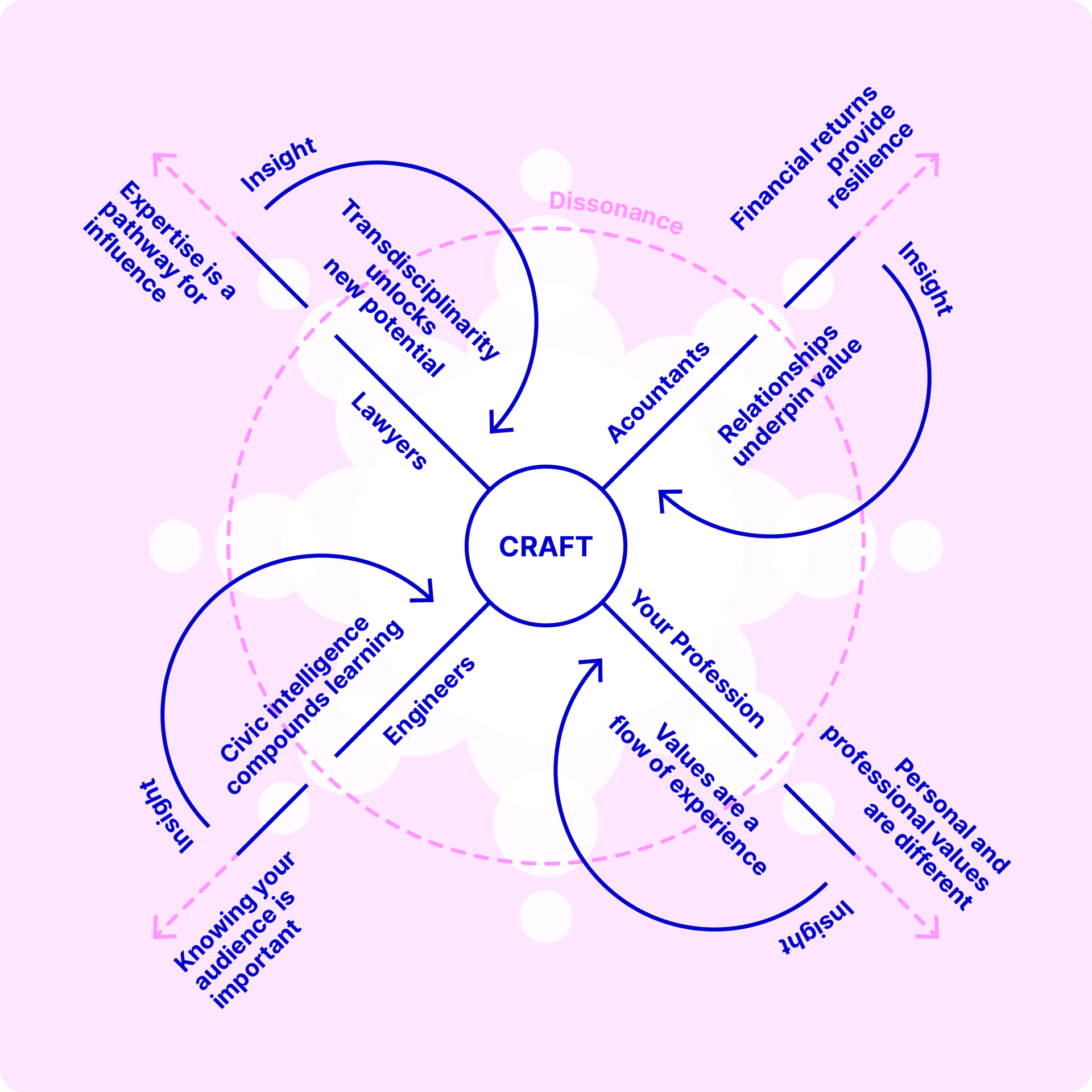
1. Understanding diverse value perspectives: In the first thread, we explore value perception through the lens of consilience; how do different actors understand value? What is valuable to someone, over which time frame, in which context and why? What are the similarities and differences between the value requirements of funders/investors and the value discovery worldview held by many value stewards? We are interested in deeply listening and understanding where people are rather than trying to convince them of anything. For example; investors might be most interested in future purchasing power or value-at-risk, lawyers in the protection of property, philanthropy in specific causes such as biodiversity or human rights, civic value stewards in the relational currencies of trust and reciprocity. Each has a valid perspective on value and we are interested in how they intersect and could potentially reinforce each other.
2. Polycapital accounting: In the second thread we work to develop practical polycapital accounting tools; what kind of value flows will need to be quantified most frequently and where are the sticking points? How can we represent different flows and perspectives of value using a common language? Can we blend the cross-cutting language of accounting with the logic of economic analysis, grounded narratives and participatory engagement?
Our working hypothesis is that we need new methods to help people make the connection between the value that they desire and the value that is being created and stewarded in the world. For example, if an investor is seeking future purchasing power but the deeper driver for that is that they are worried about severe weather events, they might be willing to invest in local climate adaptation initiatives rather than the stock market. Accountancy has huge potential as a ‘boring revolution’ lever. Almost every organisation has to prepare accounts and work with accountants. As such, it is already a globally understandable language that can be built from and intersected with other disciplines. For example, economic appraisal methodologies do consider wider value flows such as social or health impacts, but are often very detached from the contexts that they consider. Currently, accountants rarely work with economists which we see as a missed opportunity to expand the scope of what is considered, whilst remaining anchored in place-based relationships.
This work builds on many years of insight, experimentation and prototyping at Dark Matter Labs. Emily stewarded the finance and economic innovation workflows at Dm over the past 4 years and has recently transitioned into a Senior Fellow role. She combines pushing boundaries and testing new horizons with her previous experience working in international CFO and corporate finance roles. An example of some earlier thinking on this topic can be seen in a project looking at integrated financing for climate adaptation in Amsterdam, which demonstrated the potential net benefits of using an integrated, multicapital approach (equating to overall a non-discounted cost-benefit ratio of 9). It also draws on the world class design expertise and creativity of Dr Martin Lorenz, who pioneered Flexible Visual Systems and the Conversational Design principles that underpin the growing Life-Ennobling Design initiative. Emily and Martin have worked closely together over the last two years finding innovative ways of combining their different fields of expertise to scaffold life-ennobling interdisciplinary dialogues and practical action.
The wider ambition of this work is extensive and we anticipate taking a modular, collaborative approach to scale and disseminate new tools as we develop them. Examples include:
- Shared infrastructure for progressive funders and investors: in conversations with foundations who are seeking to divest and progressive impact investment advisors, we have observed a common issue. There is often a deep understanding of the need to represent holistic value more appropriately, but these actors lack the investment frameworks and accounting expertise to respond meaningfully. Unfortunately this often results in a default back to business-as-usual financial return analysis. We see potential in aligned funders pooling financial capital (and potentially existing in-house expertise) to create a shared infrastructure of next generation polycapital appraisal tools. Adjacent extensions could include holistic financial instruments, such as companies issuing polycapital dividends where financial returns are capped if the other capitals are in deficit.
- Library of diverse value creation cases: the Wealth Hackers sprint provides the opportunity to create a first real life case of value translation. We would like to build on this to present the conversational inputs and polycapital accounting outputs for a broad range of value creation projects, thus providing a practical resource for the wealth hacking (and wider) community.
- Contextual investment index: moving to the macro scale, we envisage leveraging the polycapital accounting logic to support the development of a contextual investment index. This would need to be in collaboration with a financial regulated entity and could use existing market data to visualise polycapital adjusted accounts and returns.
- Educational offering for accountants: the methodologies that are being proposed build on existing accountancy expertise (e.g. extending the logic of double entry bookkeeping) but will require socialising. We imagine developing focused offerings to support specific products initially, but would hope to expand to develop a dedicated Masters course in Polycapital Accounting in the future.






1. Prototype Polycapital ROI Tool: developing a prototype tool: The tool is anticipated to present a full set of integrated forecast financial statements (P&L, BS, Cashflow), including polycapital value flows (e.g. social, cultural, human, ecological, built) and illustrate the uplift compared to a standard financial capital forecast. Critically, the financial numbers will be presented together with the contextual narratives of value creation that were used to form the quantified inputs.
The tool and narratives will showcase the wider potential of polycapital accounting and open the conversation towards more ambitious products.
2. Open source toolkit runway: as a commitment to future work we will prepare a brief for the next phase. In this phase the aim will be to develop and share an open source toolkit that can be customised by local accountants for different contexts and needs.
3. Field Building: as part of the sprint we will seek to build a cohort of accountants and capital holders who are interested to support the next phase of work.
4. Interdisciplinary Collaborations: during the sprint, we will prioritise the identification of legal innovations that can intersect with the polycapital ROI to amplify interdisciplinary impact. For example, by developing holistic contracts that represent the value contributions of diverse actors and share associated risks equitably.